

The best health and wellness news from Michigan
Provided by AGP
Blood Banking Devices Market Size to Surpass USD 9.08 BN by 2034, Driven by Rising Number of Blood Banks Globally
NEW YORK, USA, May 05, 2026 (GLOBE NEWSWIRE) -- Zion Market Research has published a new research report titled “Blood Banking Devices Market By Product (Blood Processing Equipment, Blood Collection Equipment, and Blood Storage Equipment), By Functionality (Hospitals and Blood Banks), and By Region - Global and Regional Industry Overview, Market Intelligence, Comprehensive Analysis, Historical Data, and Forecasts 2025 - 2034” in its research database.
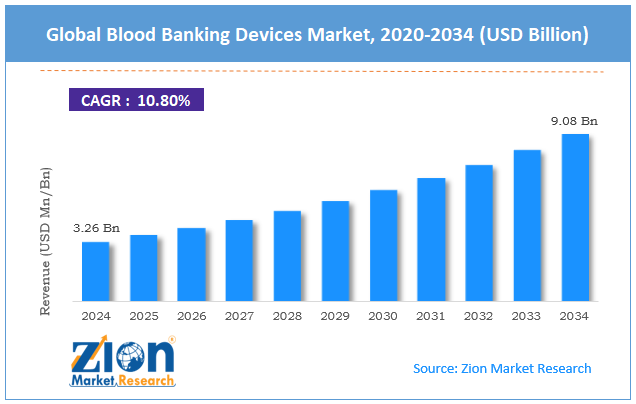
“According to the latest research study, the global blood banking devices market size was valued at around USD 3.26 billion in 2024. The market is expected to grow at a CAGR of 10.80% and is anticipated to reach a value of USD 9.08 billion by 2034.”
Get a Free Sample PDF of this Research Report for more Insights - https://www.zionmarketresearch.com/sample/blood-banking-devices-market
Blood Banking Devices Market Overview:
Blood banking devices are specialized medical tools used to collect, store, analyze, and distribute blood and blood components. Common examples include thawing equipment, freezers, refrigerators, and processing systems that maintain the integrity of blood products and prevent deterioration during handling and storage.
Several dynamics influence this market. The increasing number of blood banks and healthcare facilities drives higher demand for specialized equipment. High costs of devices and operational expenses create financial barriers to adoption and expansion. Ongoing technological advancements in automation, safety features, and efficiency offer substantial growth opportunities. Strict and evolving regulatory requirements, along with infrastructure limitations in certain regions, pose notable challenges to consistent market development.
Report Scope:
| Report Attribute | Report Details |
| Market Size in 2024 | USD 3.26 Billion |
| Market Forecast in 2034 | USD 9.08 Billion |
| Growth Rate | CAGR of 10.80% |
| Base Year | 2024 |
| Forecast Years | 2025- 2034 |
| Key Companies Covered | Beckman Coulter Inc. (a subsidiary of Danaher Corporation), Haemonetics Corporation, Abbott Laboratories, Macopharma SA, Immucor Inc., Cerus Corporation, Thermo Fisher Scientific Inc., Mitra Industries (notable in the Indian market), Fresenius Kabi AG, Grifols S.A., Ortho Clinical Diagnostics, Terumo Corporation, Siemens Healthineers AG, Becton, Dickinson and Company (BD), Bio-Rad Laboratories Inc., and others. |
| Segments Covered | By Product, By Functionality, and By Region |
| Regions Covered | North America, Europe, Asia Pacific, Latin America, and the Middle East & Africa |
| Customization Scope | Avail customized purchase options to meet your exact research needs. |
Directly Purchase a Copy of the Report | Quick Delivery Available - https://www.zionmarketresearch.com/inquiry/blood-banking-devices-market
Key Insights
- As per the analysis, the blood banking devices market share is likely to grow at a CAGR of around 10.80% between 2025 and 2034.
- The blood banking devices market size was worth around $3.26 billion in 2024 and is estimated to hit approximately $9.08 billion by 2034. Due to a variety of driving factors, the market is predicted to rise at a significant rate.
- The blood banking devices market is driven by the rising number of blood banks worldwide.
- Based on the product, the blood processing equipment segment dominates the global market as it is essential for generating critical blood components like plasma and platelets, meeting rising clinical demand.
- Based on the functionality segment, the blood banks segment dominates due to dedicated investments in advanced facilities and higher volume requirements for specialized storage and processing equipment.
- Based on the region, North America continues to dominate the global market, supported by robust healthcare infrastructure, large-scale blood supply networks like the American Red Cross, and strong adoption of advanced technologies.
Market Growth Drivers
How does the rising number of blood banks and transfusion needs propel the Blood Banking Devices market?
The global blood banking devices market experiences significant momentum from the steady increase in blood banks and collection centers worldwide. These facilities require reliable equipment for collection, testing, processing, and storage to ensure a safe blood supply for transfusions. Expansion of such infrastructure directly boosts demand for specialized devices that maintain optimal conditions for blood components.
Additionally, the growing patient population needing blood transfusions due to chronic conditions such as thalassemia, sickle cell disease, cancer, anemia, trauma, and surgical procedures further accelerates market growth. Rising global blood donations and emergency requirements from accidents and conflicts amplify the need for efficient blood management systems.
Restraints
Why do high device and operational costs limit expansion in the Blood Banking Devices market?
High acquisition and maintenance costs of blood banking devices, including refrigerators, freezers, and processing systems, restrict broader adoption, particularly in resource-constrained settings. Operational expenses related to energy consumption, consumables, and staff training add to the financial burden for many facilities.
These cost factors slow down procurement cycles and limit upgrades to newer technologies, constraining overall market volume despite underlying demand drivers.
Opportunities
How do technological advancements create prospects in the Blood Banking Devices market?
Continuous innovation in automation, safety features, and integration of AI and data analytics presents strong growth opportunities. New systems improve processing efficiency, reduce contamination risks, and enhance traceability, appealing to modern blood banks seeking higher productivity and compliance.
Emerging markets and public-private partnerships for biobanking and advanced collection methods also expand the addressable market, allowing manufacturers to introduce tailored solutions and capture new revenue streams.
Browse the full “Blood Banking Devices Market By Product (Blood Processing Equipment, Blood Collection Equipment, and Blood Storage Equipment), By Functionality (Hospitals and Blood Banks), and By Region - Global and Regional Industry Overview, Market Intelligence, Comprehensive Analysis, Historical Data, and Forecasts 2025 - 2034” Report at https://www.zionmarketresearch.com/report/blood-banking-devices-market
Blood Banking Devices Market: Segmentation
The Blood Banking Devices market is segmented by product, functionality, and region.
Based on Product Segment, the blood banking devices market is divided into blood processing equipment, blood collection equipment, and blood storage equipment. The blood processing equipment segment is the most dominant, followed by blood collection equipment. Blood processing equipment dominates the market because it is critical for separating and preparing essential components such as plasma and platelets from whole blood, directly addressing the growing clinical demand for specific blood products and thereby driving substantial market revenue and technological investment.
Based on Functionality Segment, the blood banking devices market is divided into hospitals and blood banks. The blood banks segment is the most dominant, followed by hospitals. Blood banks dominate due to their specialized focus on large-scale collection, processing, and storage operations, supported by dedicated investments in state-of-the-art facilities and higher throughput requirements that necessitate advanced and scalable equipment solutions.
Why will North America continue to dominate the global Blood Banking Devices market during the projection period?
North America is expected to maintain its leading position through its advanced healthcare infrastructure, well-established blood supply networks, and high adoption of innovative technologies. The United States serves as the primary contributor, supported by organizations like the American Red Cross that operate extensive collection and distribution centers across the country. Strong regulatory frameworks ensure high safety standards, while significant investments in modern equipment enhance operational efficiency. Robust research activities and collaborations between technology providers and healthcare institutions further accelerate innovation tailored to local needs. The region's focus on patient safety, traceability, and automation in blood management reinforces its long-term dominance.
Europe follows with strong contributions from countries emphasizing quality standards and blood safety. Asia Pacific shows rapid growth potential driven by improving healthcare access and rising demand in populous nations. Latin America and the Middle East & Africa exhibit steady development supported by expanding medical facilities and initiatives to strengthen blood supply chains.
Request For Customization - https://www.zionmarketresearch.com/custom/9647
Recent Developments
- In October 2024, Terumo Blood and Cell Technologies launched the Reveos™ Automated Blood Processing System in the US market to help blood banks improve efficiency in meeting platelet and blood supply demands.
- In March 2024, Becton Dickinson (BD) India launched the BD Vacutainer® UltraTouch™ Push Button Blood Collection Set to reduce patient discomfort and needle-related injuries during collection.
- In December 2024, BD partnered with Babson Diagnostics to expand fingertip capillary blood collection and testing solutions in the US healthcare system.
Blood Banking Devices Market: Competitive Landscape
The report contains qualitative and quantitative research on the global blood banking devices market, as well as detailed insights and development strategies employed by the leading competitors.
Some of the leading players in the global blood banking devices market include;
- Beckman Coulter Inc. (a subsidiary of Danaher Corporation)
- Haemonetics Corporation
- Abbott Laboratories
- Macopharma SA
- Immucor Inc.
- Cerus Corporation
- Thermo Fisher Scientific Inc.
- Mitra Industries (notable in the Indian market)
- Fresenius Kabi AG
- Grifols S.A.
- Ortho Clinical Diagnostics
- Terumo Corporation
- Siemens Healthineers AG
- Becton, Dickinson and Company (BD)
- Bio-Rad Laboratories Inc.
What are the key trends in the Blood Banking Devices Market?
Automation and integrated processing systems
Manufacturers are increasingly focusing on automated solutions that streamline blood processing, reduce manual handling, and improve consistency and safety in component separation and storage.
Emphasis on safety, traceability, and minimally invasive collection
There is a growing shift toward devices incorporating advanced safety features, better donor experience technologies, and digital tracking systems to meet stringent regulatory requirements and enhance overall blood supply chain efficiency.
The global blood banking devices market is segmented as follows:
By Product
- Blood Processing Equipment
- Blood Collection Equipment
- Blood Storage Equipment
By Functionality
- Hospitals
- Blood Banks
By Region
- North America
- The U.S.
- Canada
- Europe
- France
- The UK
- Spain
- Germany
- Italy
- Rest of Europe
- Asia Pacific
- China
- Japan
- India
- Southeast Asia
- Rest of Southeast Asia
- The Middle East & Africa
- GCC
- South Africa
- Rest of the Middle East & Africa
- Latin America
- Brazil
- Argentina
- Rest of Latin America
Request Free Brochure @ https://www.zionmarketresearch.com/requestbrochure/blood-banking-devices-market
Key Questions Answered in This Report:
- What are blood banking devices?
- Which key factors will influence the blood banking devices market growth over 2025-2034?
- What will be the value of the blood banking devices market during 2025-2034?
- What will be the CAGR value of the blood banking devices market during 2025-2034?
- Which region will contribute notably towards the blood banking devices market value?
- Which are the major players leveraging the blood banking devices market growth?
- What can be expected from the global blood banking devices market report?
Browse Other Related Research Reports
- Laboratory Plasticware Market By Material (Polystyrene, High-Density Polyethylene (HDPE), Low-Density Polyethylene (LDPE), Polymethylpentene (PMP), Polyvinyl Chloride (PVC), and Others), By End-User (Pharmaceutical & Biotechnology Companies, Diagnostic Centers, Research & Academic Institutes, Hospitals, and Others), and By Region - Global and Regional Industry Overview, Market Intelligence, Comprehensive Analysis, Historical Data, and Forecasts 2025 - 2034
- Atherectomy Devices Market By Product (Directional Atherectomy Devices, Rotational Atherectomy Devices, Orbital Atherectomy Devices, Laser Atherectomy Devices), By Application (Peripheral Artery Disease [PAD] Treatment Devices, Coronary Artery Disease [CAD] Intervention Devices, Carotid Artery Disease Intervention Devices, Renal Artery Disease Intervention Devices, Aortic Atherosclerosis Intervention Devices), By End-User (Hospitals, Specialty Clinics, and Others), and By Region - Global and Regional Industry Overview, Market Intelligence, Comprehensive Analysis, Historical Data, and Forecasts 2025 – 2034
- Dermatology Diagnostic Devices Market By Type (Handheld Devices, Imaging Systems, and Laboratory Diagnostic Devices), By Technology (Optical Coherence Tomography (OCT), Dermoscopy, Ultrasound Imaging, Confocal Microscopy, and Molecular & Genetic Diagnostic Techniques), By Application (Hospitals & Clinics, Dermatology Centers, and Diagnostic Laboratories), and By Region - Global and Regional Industry Overview, Market Intelligence, Comprehensive Analysis, Historical Data, and Forecasts 2025 - 2034
- Home Ventilator Market By Type (Invasive Ventilators and Non-Invasive Ventilators), By Mode (Pressure-Controlled, Volume-Controlled, and Hybrid), By Application (Chronic Obstructive Pulmonary Disease, Sleep Apnea, Neuromuscular Disorders, Post-Acute Care, and Others), and By Region – Global and Regional Industry Overview, Market Intelligence, Comprehensive Analysis, Historical Data, and Forecasts 2025 - 2034
- Capsule Endoscopy Market By Type (Small Bowel Capsule Endoscopy, Esophageal Capsule Endoscopy, Colon Capsule Endoscopy, Stomach Capsule Endoscopy), By Application (Hospital, Diagnostic Centers, Ambulatory Surgical Centers, Specialty Clinics), By End-User (Adults, Pediatrics, Geriatrics), By Technology (Wireless Capsule Endoscopy, Tethered Capsule Endoscopy, Magnetic Capsule Endoscopy), and By Region - Global and Regional Industry Overview, Market Intelligence, Comprehensive Analysis, Historical Data, and Forecasts 2025 - 2034
About Zion Market Research:
Zion Market Research is a leading market research organization offering industry expertise and scrupulous consulting services to clients for their business development. The reports and services offered by Zion Market Research are used by prestigious academic institutions, start-ups, and companies globally to measure and understand the changing international and regional business backgrounds.
Contact Us:
Zion Market Research
USA/Canada Toll Free: 1 (855) 465-4651 | Newark: 1 (302) 444-0166
India: +91 7768 006 007 | +91 7768 006 008
Email: sales@zionmarketresearch.com | Web: https://www.zionmarketresearch.com/
Follow Us on - LinkedIn | X | Facebook | Pinterest | YouTube


Legal Disclaimer:
EIN Presswire provides this news content "as is" without warranty of any kind. We do not accept any responsibility or liability for the accuracy, content, images, videos, licenses, completeness, legality, or reliability of the information contained in this article. If you have any complaints or copyright issues related to this article, kindly contact the author above.
